

Assistants
Assistants are the core of Phinite. Everything revolves around them.They are intelligent, multi-skilled entities that automate conversations, workflows, and business operations across channels. An Assistant brings together multiple components — Agent Graphs, Intents, Triggers, Tools, Environments, Builds, and Aurs — to function as a cohesive unit.
Each component plays a distinct role in defining how the Assistant behaves, interacts, and executes tasks.
Types of Assistants
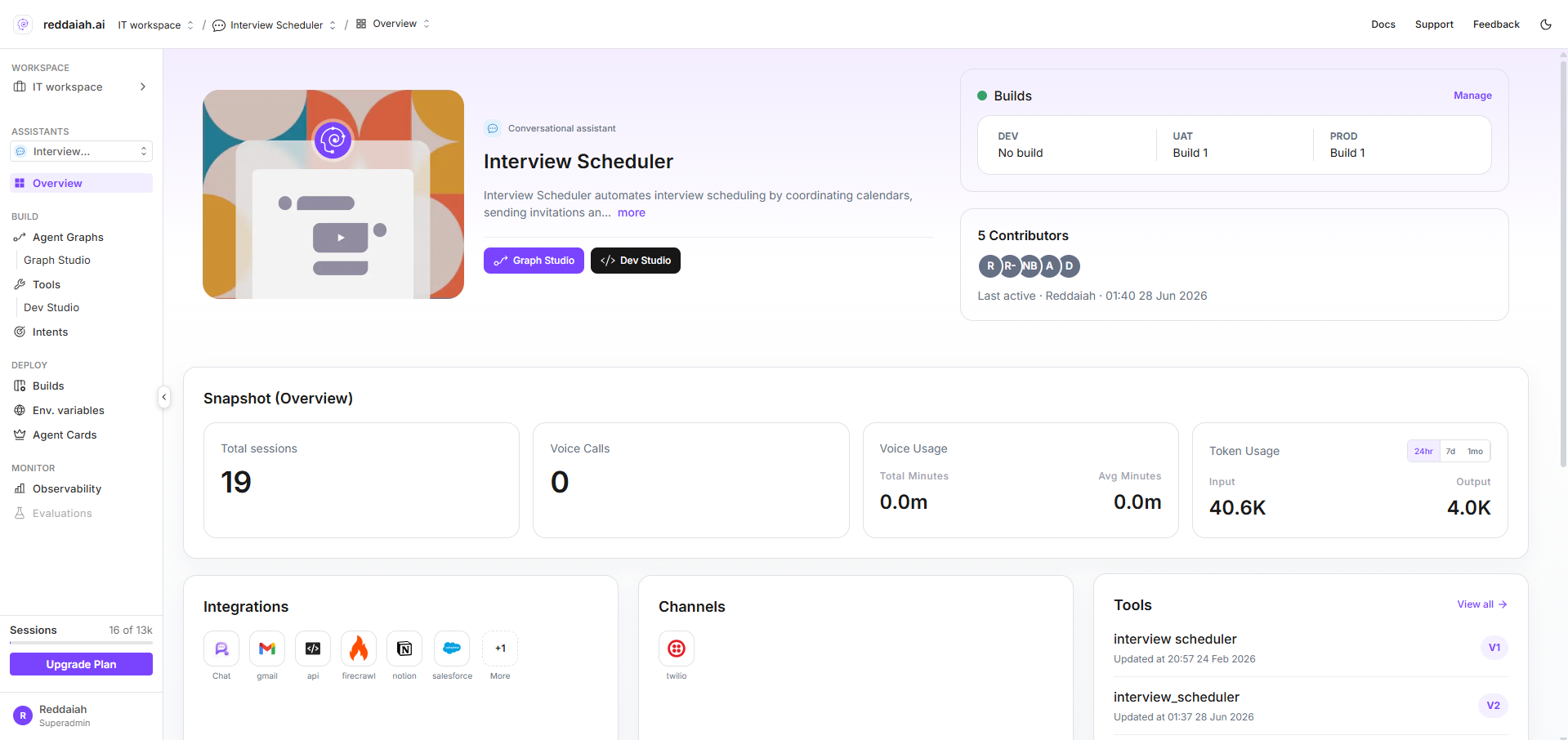
An assistant is an AI-powered capability that handles user interactions, api, background tasks and cron job using your workflows and tools.- Conversational Assistants: Chat and voice experiences
- Email Assistants: Inbox automation for triage and replies
- Autonomous Assistants: Scheduled or event-driven background jobs or apis
Comparison
🧩 Core Architecture
Agent Graphs
The heart of the Assistant — a visual workflow created in Graph Studio.
AgentGraphs connect intents, triggers, and tools to define your automation logic.
AgentGraphs connect intents, triggers, and tools to define your automation logic.
Intents(In Conversational & Email)
Natural language or programmatic cues that tell the Assistant what the user wants.
Each intent can be AI-generated and linked to a specific flow.
Each intent can be AI-generated and linked to a specific flow.
Triggers(In Autonomous)
Event-driven or scheduled conditions that automatically initiate a workflow. These triggers can originate from APIs, system events, or predefined schedules. Supports channel selection (for example, Jira), allowing direct webhook integration to trigger the process automatically.
Intents as an API
Hybrid initiators combine intent detection with trigger-based logic, making them ideal for scenarios where both a user action and a system event determine how a flow is initiated. They trigger the Intent API to start the conversation flow in the selected channel.
Custom Tools
Reusable building blocks maintained by developers in DevStudio.
They perform complex logic implementation, data processing, heavy code operation or data transformations.
They perform complex logic implementation, data processing, heavy code operation or data transformations.
Environments
Isolated spaces for development, staging, and production deployment.
Each environment controls visibility, access, and execution logs. Utilized by custom tools.
Each environment controls visibility, access, and execution logs. Utilized by custom tools.
Builds
Snapshot versions of an Assistant. Builds preserve dependencies, flows, and configurations across environments for controlled release and rollback.
Phinite Aura
AI-powered assistant that helps you generate agent graphs.
It understands context and build and edits agent nodes intelligently.
It understands context and build and edits agent nodes intelligently.
Agent Registry (A2A)
Expose published agent graphs as discoverable Agent Cards, browse the workspace catalog, and compose multi-agent flows with Browse or Discovery registry nodes.
⚙️ How an Assistant Works
Each Assistant operates as a closed loop of logic and action.- Trigger or Intent fires
- Initiates a Agent Graph.
- Agent Graph executes
- Moves across blocks — Agent, Tool, Logic, or Connector.
- Tools perform operations
- API calls, data validation, transformations.
- Responses return to the user or system
- Completing the workflow cycle.
- Logs and observability
- All executions are tracked under the Environment dashboard.
💡 Creating an Assistant
1
Go to Assistants → Create Assistant
Navigate to your workspace and select Create Assistant.
2
Define Type
Choose between Conversational, Autonomous, or **Email **assistants.
3
Design Agent Graph
Open Graph Studio to visually create the graph using Agents Node.
4
Link Intents or Triggers
Each flow must be linked to a Trigger or Intent(depending on assistant type) to define its entry point.
5
Attach Tools
Add logic or data connectors from DevStudio’s tool library.
6
Configure Environments
Assign environment settings for Dev, UAT, or Production.
7
Build and Deploy
Finalize and attach environment the Assistant as a versioned build.
🤖 Aura
Aura accelerates assistant creation by generating agent graphs, tools using natural language.Usage
- Ask: “Create a flow to schedule a site visit and confirm via email.”
- Aura will suggest and build the structure, tool connections, and agent messages.
- You can edit or refine before deploying.
🧭 Summary
Assistants in Phinite unify conversation, automation, and integration into a single, agentic architecture.They connect human intent with machine precision — through agent graph, tools, and triggers — to deliver intelligent, observable, and scalable outcomes.
Everything in Phinite starts and ends with an Assistants.
Design it well — and every automation across your workspace becomes effortless.
Design it well — and every automation across your workspace becomes effortless.
Next steps
- Explore Types of Assistants
- Review Assistant Components
- Build your first flow in Graph Studio
- Expose agents for external discovery in Agent Registry